Find the right crate size for your dog
Choosing the right crate starts with your dog, not simply their breed. Two dogs of the same breed can be different sizes, so use your dog’s actual measurements whenever possible.
This guide will show you what to measure, how much room your dog needs, and how to compare those measurements with the internal dimensions of a crate before you buy.
The simple rule
Your dog should have enough room to stand normally, turn around and lie down comfortably. Both MidWest and Petmate use those basic fit tests in their sizing guidance.
How to Measure Your Dog
For the most reliable starting point, measure your dog while they are fully grown and standing naturally.
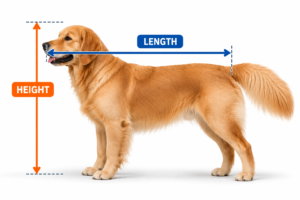
1. Measure the length
Measure in a straight line from the tip of your dog’s nose to the base of the tail — where the tail joins the body.
Do not measure to the end of the tail.
2. Measure the height
With your dog standing naturally, measure from the floor to the top of the head. If your dog’s ears stand higher than the head, make sure the crate provides enough clearance for them too.
3. Check the manufacturer’s sizing instructions
Manufacturers don’t all use exactly the same sizing method. Some recommend adding a specific amount to your dog’s measurements; others provide their own size chart.
Always compare your dog’s measurements with the manufacturer’s dimensions and sizing instructions for the exact crate you are considering.
Remember: The finished crate must still allow your dog to stand at full height, turn around, stretch out and lie down naturally.
From Dog Measurements to Crate Size
Your dog’s measurements are the starting point — not the crate size printed on the box.
Once you have measured your dog, look at the dimensions of the actual crate you are considering. Allow enough extra room for your dog to stand naturally, turn around and lie down comfortably.
Some manufacturers recommend adding around 2–4 inches (5–10 cm) to your dog’s measurements, but always follow the sizing instructions for the particular crate you are buying.
Check the internal dimensions whenever they are available. A crate described as “40 inch” does not necessarily provide 40 inches of usable space inside.
If your dog falls between two sizes: check the manufacturer’s guidance and the actual internal dimensions rather than automatically choosing by the size name alone.
Choosing a Crate for a Puppy
If you are buying a crate for a puppy, think about the size of crate they are likely to need when fully grown.
Some wire crates are supplied with a divider panel. This allows the usable area of an adult-size crate to be reduced while your puppy is small and gradually increased as they grow. Always use the divider according to the crate manufacturer’s instructions.
Your puppy should still have enough room to stand naturally, turn around and lie down comfortably.
If your puppy’s eventual adult size is difficult to predict — particularly with a crossbreed — you may need to reassess the crate size as they grow.
Important: A crate suitable for use at home is not automatically suitable for transporting a puppy. The RSPCA specifically advises against travelling with a puppy in an oversized adult crate.